Point Zafire at your own code
one command, five minutes.
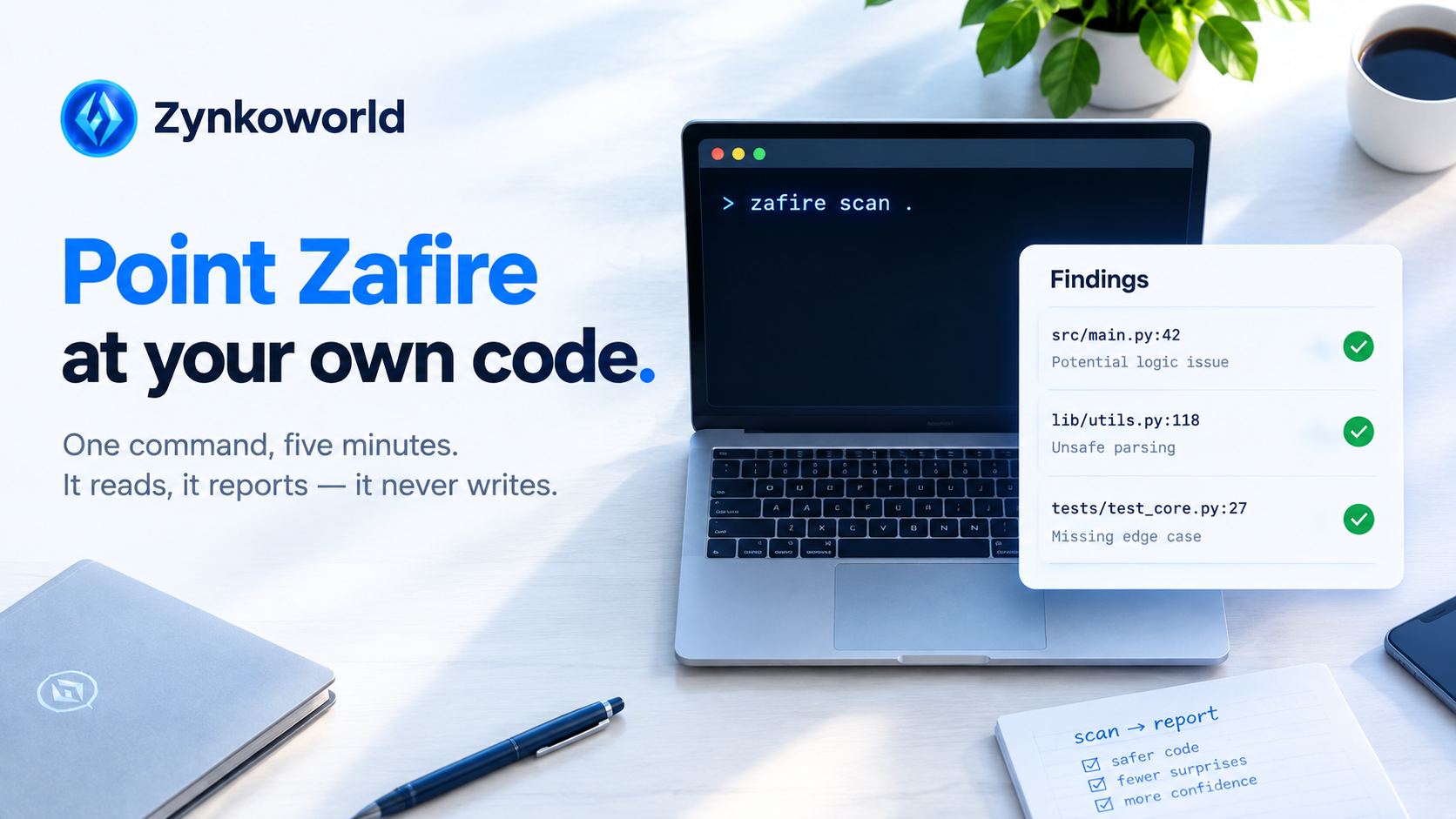
Zafire Basic is a read-only bug-finder. It finds real bugs — demonstrated, not guessed — points to the exact line, and keeps the findings as structured JSON. It runs sealed and offline, and never writes to your code.
Not ready to download yet. We're finishing it now. When it's out, Basic A is free for everyone who has connected a machine — so connecting now is the first step. Follow us on Facebook to hear when it's ready.
Basic A is free — it comes with connecting your machine. Basic B, C and the higher tiers are on the roadmap. See the whole map →
Connect your machine first — free →Basic A comes with joining — you take a role in a field, and your machine does the proving.
Join with your machine →Point it at your project and run it. No account to create — your machine's key is its identity.
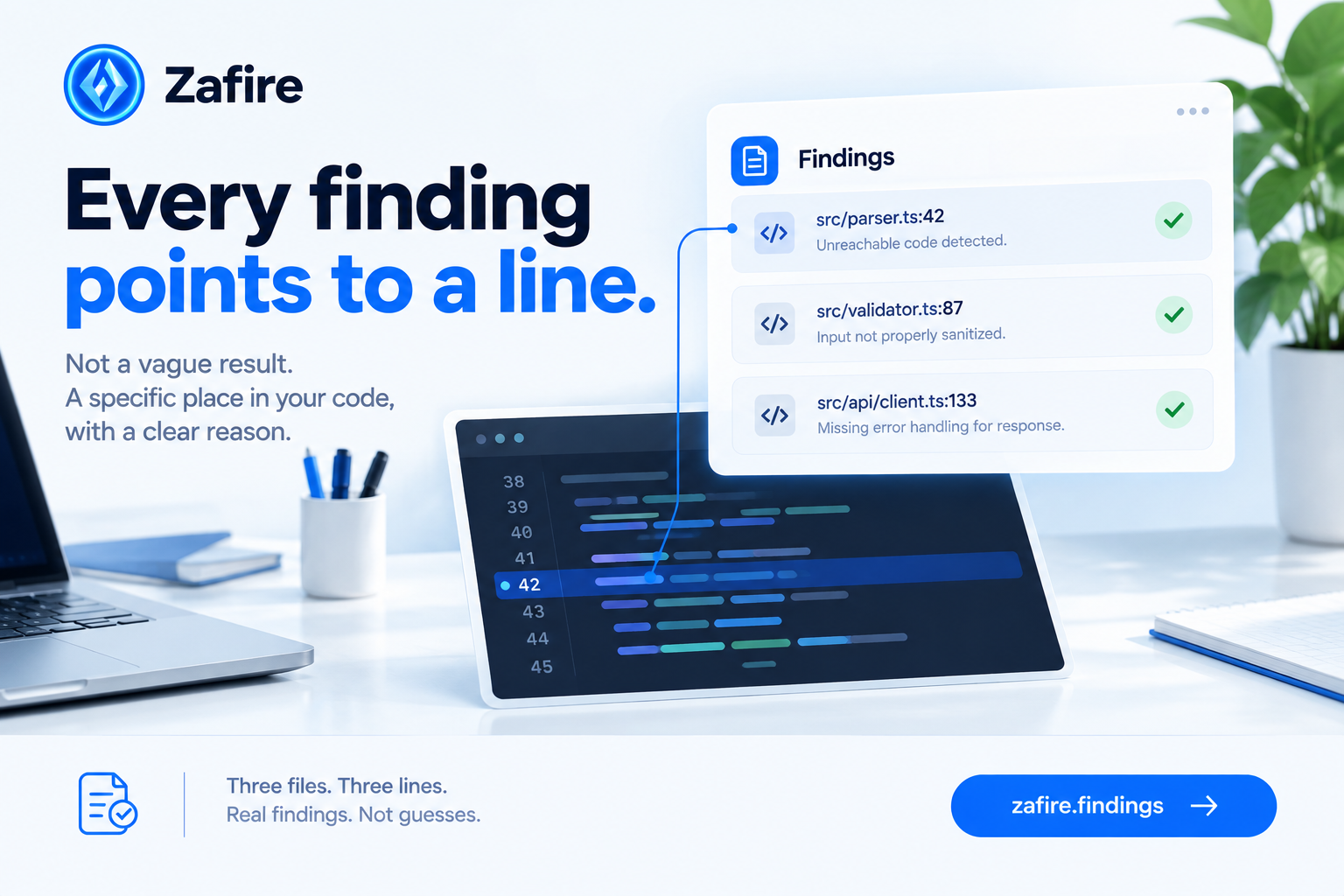
Coming soonEvery finding points to the exact line, saved as structured JSON. It shows what's there and never touches your code.
Read-only · sealed · offlineThe pricing model in one sentence
Without tokens. No credits. No metering.
Every AI product you've used bills by the token — every run, every retry, every revision moves the bill. Zafire doesn't meter you: a plan is one flat price, and One Tool is built once and then it's yours. Run it all day, retry as much as you want — the bill doesn't move.
Zafire · Basic — read-only analysis
zero write risk▾It reads your codebase and tells you the truth about it.
Deep analysis, fully offline: risks, complexity hotspots, likely-unused code — every finding cited to the exact place in your source, verified by the engine before you see it. It proposes; it never writes a byte. If you want a second pair of eyes that cannot break anything, this is it.
- Reads & analyzes your codebase
- Engine-verified citations — no fabricated findings
- Sandboxed & fully offline (no network)
- Never modifies your code
Concorde · Pro — fixes what it finds, under a human gate
on the roadmap▾It plans and writes code — and you stay the gate.
Everything in Basic, plus gated writing: Zafire plans the change, writes it in a sandbox, runs your tests, and auto-reverts anything that regresses or games the suite. You review the validated diff and you commit. Deterministic, audited, and it never acts past the gate.
- Everything in Basic
- Plans & writes code behind a mandatory gate
- Runs your tests; auto-reverts regressions
- You review the validated diff & commit
- No self-improvement
One Tool — built & proven, then it's yours
for people who don't write code▾Tell us the machine. We build the missing tool and prove it.
You work with gear, formats or software nobody wrote a tool for — and you don't want to code. Describe the device and the job; we build the tool, verify it until every claim it makes resolves to a passing test, and hand it over. It runs on your machine, offline, at ~zero cost per run — you verify it the way you already know: on the gear. One price, once.
- We build the missing tool for your device or format
- Verified before you get it — every claim resolves to a passing test
- Runs offline on your machine, forever
- No subscription — built once, then it's yours
Polaris · Enterprise — writes the code, scales across machines
on the roadmap▾A sealed sovereign box that grows its own missing tools.
Everything in Pro, plus self-improvement: when a capability is missing, the box generates the tool for it — under the same verification discipline as everything else. Runs air-gapped in a sealed box on your infrastructure, with full audit, rollback and registry history. Your data never leaves your building; neither does the machine that works on it.
- Everything in Pro
- Self-improving — generates missing tools
- Sovereign box: air-gapped & sealed
- Full audit, rollback & registry history
- On-prem & priority support
What stays true on every tier
no metering, no upload, no phone-homeStraight answers
the things you'd otherwise have to askNo. There is nothing to count — no tokens, no credits, no per-run fees. Basic A is free when you connect your machine; the higher tiers are on the roadmap, and pricing will come later. Your usage will never be metered — that's the point of a tool that runs on your own machine.
No. This page is the whole process: read, connect your machine, run it. There is no sales team to route you to — by design.
No. Zafire runs where your work already is — no project upload, no third-party model on your source. Offline and air-gapped operation isn't a premium tier; it's the only way it works.
Every claim ships with the test that proves it, and you can run those tests yourself, on your own machine. That's the standard everything here is held to: we don't promise — we prove.
With Zafire Basic A — it only reads, and it's free when you connect your machine. Concorde (Pro: it fixes what it finds, you keep the final word) and Polaris (Enterprise: it writes the code and scales across machines) are on the roadmap.